Newspapers and magazines. Both convey information through text, photos, graphics and illustrations. Both reach millions of people every day. Both have traditionally been a prime example of print media. The similarities are high, but their differences outnumber these greatly.
Newspapers target a large population, while magazines are more specialized. Magazines are more editorial (entertainment based), where newspapers are largely factual (information based). Newspapers often have a much quicker turnaround time, coming out daily, bi-weekly or weekly, while many magazines are monthly or even quarterly. Magazines are typically printed on a heavier, glossier paper and newspapers are printed on a thiner, porous paper. For these reasons, as well as many others that I didn't list, newspaper and magazine design differs greatly.
The factual, 'hard news' format of newspapers is, perhaps, the most significant reason for the differentiation in design. The strict, column-based grid structure of newspapers projects credibility. This comes from years and years of similar newspaper design. We as consumers, tend to give more trust to the things that we are familiar with. A reverse example of this, is the adoption of this type of layout by gossip tabloids. By printing on newsprint and adhering to a newspaper-like column structure, they hope to appear credible and factual. Newspapers are also dictated by a number of other factors, including a quick turnover time, lower quality paper, whether or not they will have color, etc.
Because magazines are typically more entertainment based, they are able to play with design more as they are not bound by the constraints of being the watch dog informant. They are also almost always full color and printed on a heavier, glossy paper stock, allowing for more detailed, intricate designs.
As of recent though, newspapers have begun to morph and change slightly in order to compete as a print product living in a digital age and are becoming more design heavy and magazine-like as to attract readers and get them their information in an easily manageable and relatively entertaining way.

Showing posts with label Going Deeper. Show all posts
Showing posts with label Going Deeper. Show all posts
Monday, April 2, 2012


Sunday, March 18, 2012
Typography: The Cost of Fonts
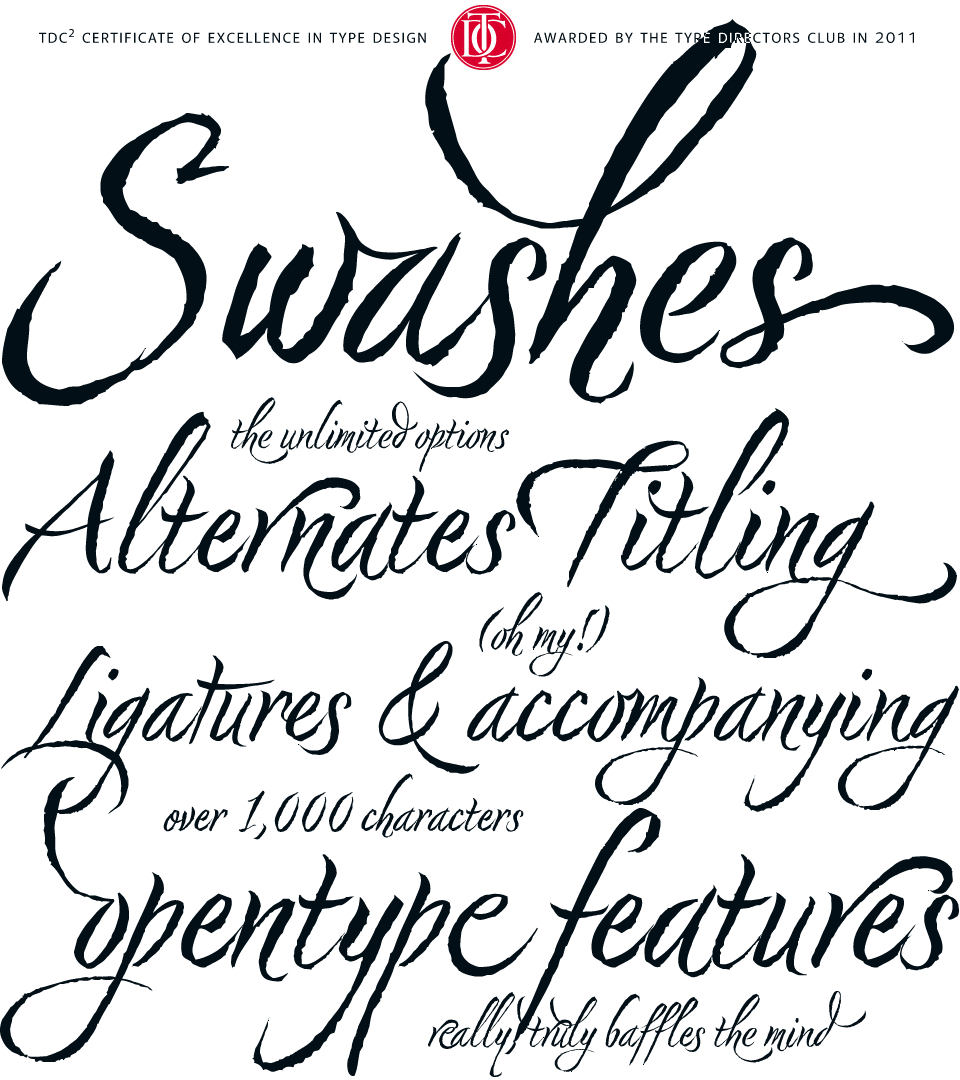 |
Nori by Niel Summerour, is a hand-lettered typeface that
contains over 1100 glyphs, 250 ligatures, 487 alternate
characters, 125+ swash and titling alternates, lining and
old style numerals.
|
Buying and owning fonts. This was a concept that was alien to me before beginning the graphic communications program. Fonts where just something that came along with Word. You had what you had and you made due with them. I knew nothing about where fonts came from, how I got the ones I had or that I could even get more.
Upon entering design school, I -- like many beginning designers -- dove head first into the free font sites. Countless different typefaces, all free for my using. "Why pay upwards of $40 for 'commercial' fonts when I can download all the fonts I could ever need for free," I thought.
Well, as time, experience and education often do, I was quickly shown the error of my ways and learned that free fonts are free for a reason, and even though I can download them for free, it doesn't mean that I can freely use them for any project. As outlined in the article, "Why are font so expensive?" from 1stwebdesigner.com , you truly do get what you pay for and an exorbitant number of these free fonts are very low quality. But what makes a font low quality? Free fonts will often lack consistency throughout letterforms, have irregular or "botchy" curves, have missing characters, very few will have any alternates or special ligatures or any thought given to kerning. Also, free fonts rarely come in more that one style or weight, drastically reducing their usage. In addition to this, many of these "free" fonts are only free for personal use. As soon as you use them commercially, licensure issues come into play.
OK, so now I knew why free fonts aren't all that they are cracked up to be, but I still didn't understand why professional quality fonts cost as much as they do. This I didn't learn until I began creating my own fonts. There is a huge amount of time that goes into the planning and drawing of characters in a font. This is some of what you pay for but the real value of commercial fonts comes in the technical aspects and math associated with them -- the attention given to spacing between specific letters. This is important, for example, because an "i" and "g" will fit together very differently than an "s" and a "g," and if all of the letters are just quickly knocked out and given the same spacing, it creates strange gaps and words become disjointed and therefore less legible. Commercial fonts will almost always come in different weights, making them much more useable for a variety of different purposes. In addition to this, many higher quality fonts, especially script and handwritten fonts, will come with a built in set of ligatures and alternates. These fonts will come at a higher cost as these special features require additional thought, planning and time executing them.
Thursday, September 1, 2011
Going Deeper: Helvetica Neue
Through the 1960s and '70s Helvetica grew in popularity as the modernism trend took hold. Today, however, it is viewed by some as overused, plain or tired. I don't agree though. It is clean, strong and simple, lending itself to many, varied uses, and with the addition of Helvetica Neue (neue meaning new in German) it truly has endless possibilities.
Since Helvetica's creation, is has been re-designed and refined by a number of designers to give it a larger variety of weights. This made things difficult as different weights designed by different designers were given the same or similar names or the same weight often had different names.
In 1983, it was reworked as a complete set by D.Stempel AG, the daughter company of Linotype, and Helvetica Neue was born. Differences in alignment were corrected, subtle features were made consistent from one face to another, and all the weights and widths were designed to work together as one family. Changes included improved legibility, heavier punctuation marks, and increased spacing in the numbers. The outcome was a synthesis of aesthetic and technical refinements that resulted in improved appearance, legibility and usefulness. (www.fonts.com)
The font family is made up of 51 fonts including 9 weights in 3 widths, and an outline font based on Helvetica 75 Bold.


Sources:
Thursday, July 21, 2011
Going Deeper: The Balancing Act that is Graphic Design
Design is the search for a magical balance between business and art; art and craft; intuition and reason; concept and detail; playfulness and formality; client and designer; designer and printer; and printer and public.
— Valerie Pettis
Connecticut-based Graphic Designer
“Design is the search for a magical balance …” This part of the quote by Connecticut-based graphic designer Valerie Pettis really sticks out in my mind. I think that this is the one things that I have really learned through my classes and teachers in the graphics program at Southeast Tech., that graphic design is truly a balancing act. In every design, designers are saddled with the task balancing a whole host of contrasting ideas to create visual pieces containing both aesthetically pleasing art and a specific message. But what is a graphic designer and does it actually take to be one, besides a good sense of balance, that is?
Through this post I will explore what a graphic designer is, the qualifications, skills and education required to be a design professional, the basic duties of a designer, as well as the job specifics, such as job availability and projected median pay.
Through this post I will explore what a graphic designer is, the qualifications, skills and education required to be a design professional, the basic duties of a designer, as well as the job specifics, such as job availability and projected median pay.
Graphic design combines art and technology to communicate ideas. The designer works with a variety of communication tools, primarily image and typography, in order to convey a message from a client to a particular audience. Designers create, choose, and organize these elements — typography, images, and the so-called “white space” around them — to communicate a message.
Graphic designers use many drawn, painted, photographed, and now computer-generated images to create the design for graphics and layouts for a variety of visual pieces and formats such as print pieces, including business cards, letter heads, posters, fliers, brochures, maps and info-graphics. They might also develop the entire layout of magazines, newspapers, journals or websites.
In addition to these finished projects, they also design the letterforms that make up various typefaces that can be seen everywhere from movie credits and TV ads to books, magazines, and menus, and even on computer screens. There would be no electronic words anywhere if a designer hadn’t created the fonts first.
In the graphic design profession, it is often the case that formal training is not necessarily needed to be successful, but often it can be difficult to pick up the required skills well enough to make a living without at least some sort of degree in art or graphic design. For most professional graphic design positions, it is required that the applicant have a bachelor's degree, although many entry-level technical jobs only require an associate degree.
Through professional design training, either a bachelor’s or associate degree program, fledgling designers usually receive knowledge of studio art and design, commercial graphics production, computerized design, and website development and design. One major part of these programs is that they allow the design students the opportunity to complete of number of original, professional type projects and skills sets in order to put together a good portfolio before entering the job market, which is often crucial in getting a job.
Along with postsecondary training, creativity, communication, and problem-solving are very important skills for a designer to posses and develop. Designers must be creative and able to communicate their ideas visually, verbally, and in writing. They also must have an eye for details.
Because consumer tastes can, and often do, change fairly quickly, designers also need to widen their world-view by keeping up with professional design literature, being open to new ideas and influences, and must be able to react quickly to changing trends. The abilities to work without direction and under the pressure of deadlines are equally important traits. Other important skills needed by designers are the self-discipline to start projects on their own, the ability to budget their time, and to meet deadlines and production schedules. In addition to these, good business sense and sales ability can also prove themselves useful to designers, especially for those who plan to freelance or manage their own firms.
It is also very important that graphic designers keep up with new and updated computer graphics and design software, either on their own or through formal software training programs.
Rapid growth is projected for the graphic design field as well as the jobs associated with it. Employment of graphic designers is expected to grow 13 percent, as fast as the average for all occupations from 2008 to 2018, as the continued growth of the Internet will provide many new job opportunities, and businesses will always have the need for visually appealing documents and communication to help with their advertising and marketing. However, growth may slow due to reduced demand for print publishing, where many graphic designers are employed.
The average annual wages in May 2008 for graphic designers were $42,400. The middle 50 percent earned between $32,600 and $56,620, while the lowest 10 percent earned less than $26,110, and the highest 10 percent earned more than $74,660. A more specific breakdown can be seen in the chart below:
Position | Average Salary (As of May 2008) |
Staff Level Designers | $45,000 |
Senior Designers | $60,000 |
Solo-Freelance Designers | $57,000 |
Design Directors | $95,000 |
Design Firm Owners/Partners | $95,000 |
With the growth of the industry expected to continually climb with new technologies, skilled, creative and dedicated newcomers should find it a welcoming industry to work their way into and advance their careers in. They will join a new generation of proverbial trapeze artists in the balancing act that is the graphic design field.
Sources:
Graphic Designer: Educational Requirements for a Career in Graphic Design
Graphic Design: A Career Guide and Education Directory by Sharon Helmer Poggenpohl
United States Department of Labor, Bureau of Labor Statistics
Wednesday, May 4, 2011
Going Deeper: Paisley

We've all seen it. Its distinctive swirling, teardrop or tadpole shape can be seen everywhere from neck ties, shirts and scarves to wall paper. It's intricate. It's bright. It's often polyester. It is paisley.
For something so present in our world, I found that I know very little about it. Where did it originate? What does it represent?
The World English Dictionary defines it as "a pattern of small curving shapes with intricate detailing, usually printed in bright colors."
In her article, "Paisley: A Brief History," Patricia L. Cummings puts paisley's roots in the textile making industry in Persia, from 1501 to 1736. She says that at that time the pattern was referred to as boteh. Boteh is an anglicized version of the Hindi word, buta, which means flower.
Cummings goes on to say, that the pattern was later seen woven into shawls in the Kashmir valley in the Himalayas in the 17th century. It is believed that British soldiers brought back these shawls after serving in India in the second Anglo-Sikh War and their popularity spread across Europe.
With the demand for the shawls growing, the town of Paisley, Scotland became the first site to manufacture Kashmiri knock-off shawls on an industrial level, and from there the pattern eventually became known as paisley.
Over the years different areas have adapted the design to their own region. In India it commonly took on a drooping bud form and was known as the "Indian Pine Cone." In Europe it was commonly referred to as the "Kashmir Cone" and often took on the shape of a seed pod. In Russia, the design took on a more cucumber like shape. Cummings says, that over time, the forms moved away from region specific designs and became "more integrated with other fill-in, floral designs" eventually giving us the modern paisley design.
Recently, I was inspired while arranging my tie collection, and created my own paisley design, which is pictured above. (Side Note: I have a strange obsession with polyester ties. I have 18 of them, four of which are paisley.)
Subscribe to:
Posts (Atom)